The 2025 AI Timeline: From Chatbots to Thinking Agents
Looking back from the start of 2026, it is clear that 2025 was the year the AI industry underwent a fundamental paradigm shift. We moved away from the "Chatbot Era"—where AI was a clever parlor trick for writing emails—and entered the "Agentic Era." In 2025, AI stopped being a tool you use and started becoming an employee you manage. For agencies and developers, the focus shifted from "How do I prompt this?" to "How do I orchestrate this?" Here is the definitive timeline of the breakthroughs that reshaped our digital world over the last twelve months.
Q1: The Efficiency Wake-up Call
The year began with a massive disruption that shattered the assumption that only trillion-dollar Silicon Valley giants could build world-class AI.
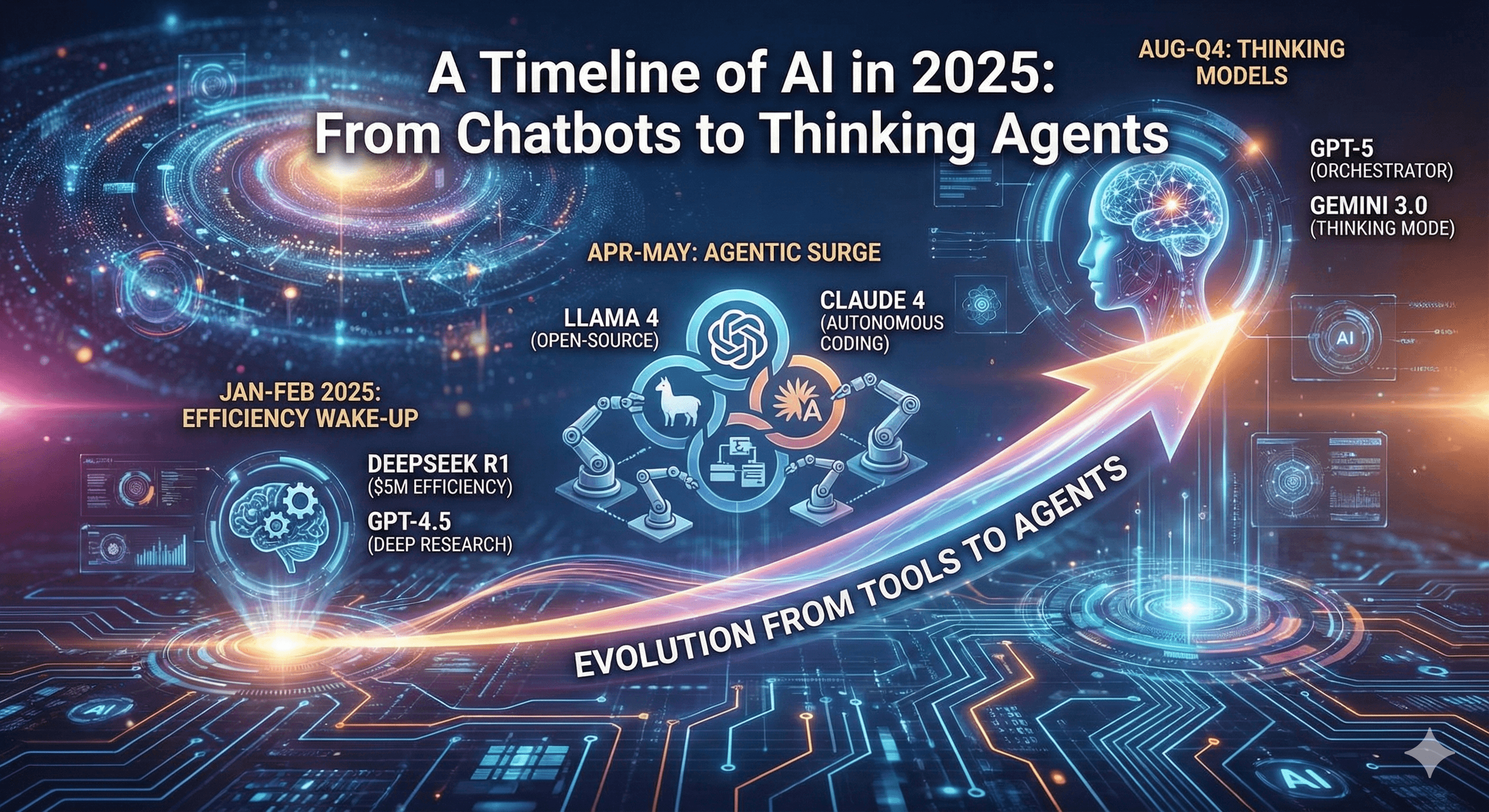
DeepSeek R1 (January 20, 2025): This was the "shot heard 'round the world" for AI economics. A relatively small Chinese lab released R1, a model that matched GPT-4o’s reasoning capabilities but cost only a fraction (approx. 3-5%) to train. It utilized Group Relative Policy Optimization (GRPO) and Long Chain-of-Thought (CoT), proving that architectural efficiency was more important than raw compute spend.
OpenAI GPT-4.5 (February 2025): OpenAI responded by bridging the gap between their standard models and their reasoning-heavy "o-series." GPT-4.5 introduced Deep Research, a feature that allowed the model to spend up to 20 minutes scouring the web to produce a 30-page research paper. This was the first mainstream sign that AI was moving toward "long-horizon" tasks.
Q2: The Open-Source & Agentic Surge
By Spring, the focus shifted toward democratization and autonomous "workdays."
Llama 4 (April 5, 2025): Meta released the Llama 4 family, including Scout (17B) and Maverick (400B). Llama 4 was a "Mixture-of-Experts" (MoE) masterpiece, offering multimodal capabilities (native vision and text) in an open-source format. This release allowed agencies like Codeamesh to host "PhD-level" intelligence on private servers, offering clients 100% data privacy without sacrificing performance.
Claude 4 (May 22, 2025): Anthropic reclaimed the "Coding King" title with the release of Claude Opus 4 and Sonnet 4. This was a pivotal moment for software development. Opus 4 demonstrated the ability to work autonomously for up to 72 hours on a single coding ticket. Companies began using "Claude Code" to refactor entire legacy codebases overnight with minimal human intervention. It introduced Persistent Memory Files, allowing the AI to remember project context across thousands of interactions without "losing its mind."
Q3: The Great Leap – GPT-5 and the Unified Interface
The summer of 2025 saw the release of the most anticipated model in history, fundamentally changing how humans interact with computers.
GPT-5 (August 7, 2025): OpenAI did not just release a faster chatbot; they released an Orchestrator. GPT-5 unified reasoning (formerly the o-series) and creative generation into a single interface.
Ph.D. Level Reasoning: GPT-5 became the first model to consistently score at the 90th percentile in the International Math Olympiad and professional-level coding benchmarks (SWE-bench).
Agentic Native: It was the first model designed specifically to "chain tools." Instead of a user saying "Search Google and tell me X," the user would say "Plan my 3-day business trip to Dubai, book the flights that fit my budget, and add the itinerary to my calendar." GPT-5 would execute the entire chain autonomously.
Q4: The Rise of "Thinking Models" and Orchestration
As the year closed, the industry moved toward "Slow AI"—models that prioritize accuracy over instant gratification.
Thinking vs. Instant Modes: Leading providers (OpenAI, Google with Gemini 3.0, and Anthropic) introduced a toggle. Users could choose "Instant" for basic text or "Thinking Mode" for complex architecture and logic. In Thinking Mode, the AI spends 10–60 seconds "deliberating" internally before producing a near-flawless output.
The Orchestrator Era: By December 2025, we saw the rise of Multi-Agent Systems. A lead "Manager" agent (like GPT-5 Pro) would now delegate tasks to specialized "Worker" agents (like Llama 4 Scout for research or Claude Haiku for fast classification). This decentralized intelligence became the standard for enterprise automation.
The Biggest Change: From Tools to Digital Employees
If 2024 was about "Generative AI," 2025 was about "Agentic AI." The shift can be summarized in three core pillars that now define the 2026 landscape:
1. Reasoning-First Architectures
We stopped training models to just "predict the next word." Thanks to breakthroughs in Reinforcement Learning from Human Feedback (RLHF) and specialized reasoning datasets, models now "think" before they speak. This has reduced hallucinations by nearly 45%, making AI safe enough for high-stakes industries like Healthcare, Finance, and Legal.
2. Long-Horizon Autonomy
In 2024, AI had a 5-minute attention span. By the end of 2025, models like Claude Opus 4 and GPT-5 Pro could maintain focus on a single task for days. This enabled the first true "AI Employees"—systems that can manage a customer support ticket from the initial complaint all the way to a processed refund and a follow-up satisfaction survey without a human touching the keyboard.
3. The Death of the "Prompt"
As AI became more intelligent, "Prompt Engineering" became a legacy skill. Current systems are Intent-Driven. You no longer need to write a 3-page prompt with specific constraints. You simply state your business goal, and the AI asks you clarifying questions to build its own execution plan.
Conclusion: Navigating 2026 with Codeamesh
The rapid-fire releases of 2025 have created a massive gap between businesses that use AI and businesses that are "AI-Native." At Codeamesh, we spent the last year integrating these milestones into real-world workflows for our clients. Whether it was helping JMM move from offline chaos to a fully automated SaaS platform or building AI voice agents for Values and Vision that sound indistinguishable from humans, our focus remains the same: ROI over Hype.
The 2025 timeline proved that the tech is ready. The question for 2026 is no longer "What can AI do?" but "How fast can your business adapt to an AI-driven world?"
Ready to turn these 2025 breakthroughs into your 2026 growth? Let’s talk.
About author
Turning complex business bottlenecks into seamless, AI-driven digital realities.

Prathamesh Ashra
Lead Consultant
Subscribe to our newsletter
Sign up to get the most recent blog articles in your email every week.